
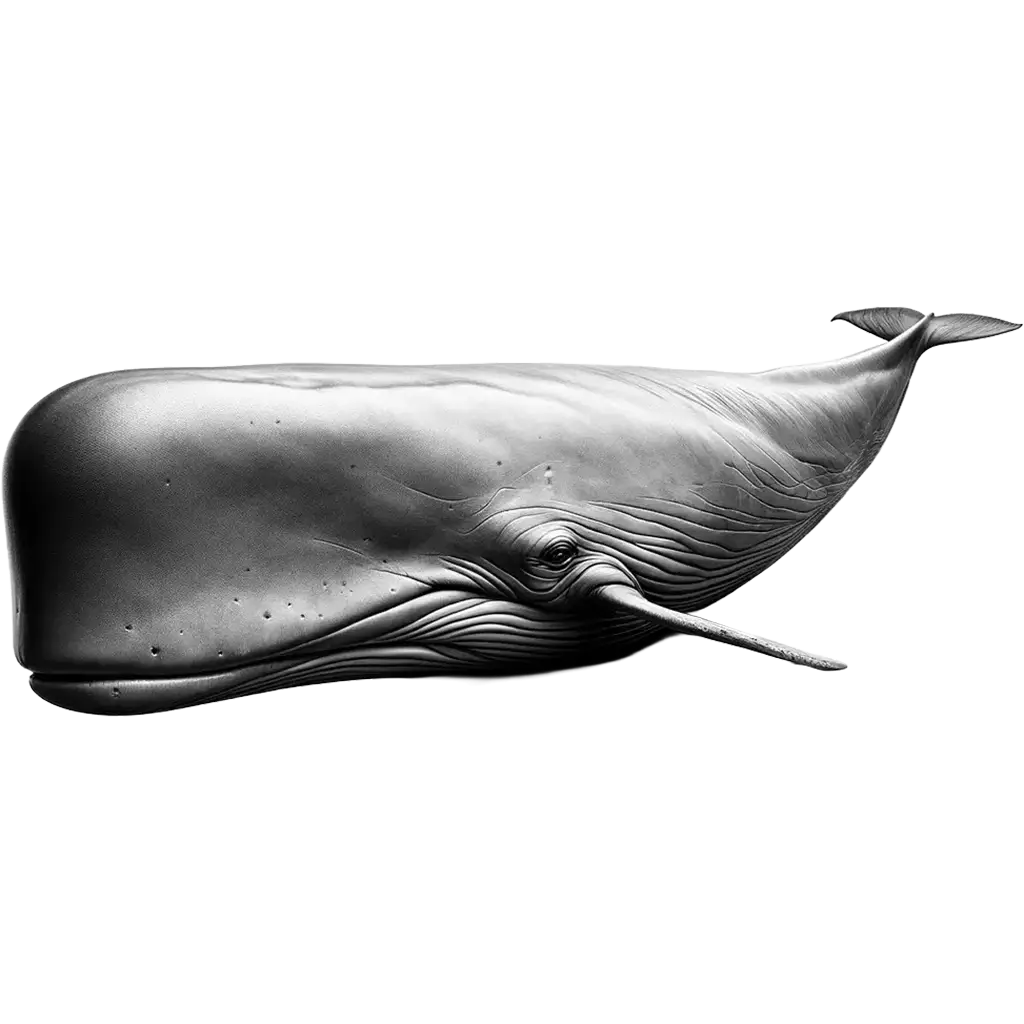
Physeter Macrocephalus
Sperm Whale
Deep oceans worldwide, from the equator to the edges of the polar ice
The Sperm Whale, physeter macrocephalus, holds the title of the largest toothed predator and the deepest diving mammal, renowned for its remarkable adaptations to life in the deep ocean. Adult males can reach lengths of up to 20 meters and weigh over 50 tons, making them significantly larger than females. The most distinctive feature of the Sperm Whale is its enormous head, which can constitute up to one-third of the animal's total body length and houses the spermaceti organ, historically hunted for its valuable oil. The whale's skin is dark gray to black, with a wrinkled appearance that aids in thermoregulation.
| Population: | Listed as Vulnerable due to past whaling and ongoing threats |
| Generation Length: | 20-30 years |
| Average Weight: | 35-45 tonnes |
| Average Length: | Up to 18 meters for males, females are smaller |
| Lifespan: | 60-70 years, sometimes longer |
| Diet: | Primarily teuthophagous (squid-eating) |
| Conservation Status: | Vulnerable (VU) |
Sperm Whales are found in oceans around the world, from the Arctic to the Antarctic, preferring deep waters where they hunt for their primary prey, squid, including the giant squid. They are capable of diving to depths of over 2,000 meters and holding their breath for up to 90 minutes. These whales are social animals, with females and juveniles forming groups, while adult males tend to lead more solitary lives, joining groups only during the breeding season.
The diet of the Sperm Whale is predominantly deep-sea squid, but it also includes fish and octopuses. Their unique hunting technique involves echolocation, emitting powerful clicks to locate and stun their prey in the dark depths of the ocean. This ability showcases the Sperm Whale's adaptation to its deep-sea environment.
Reproduction in Sperm Whales is not fully understood but is known to occur every 4 to 20 years for females, with a gestation period of about 15 months. Females give birth to a single calf, which they nurse for several years. The social structure of Sperm Whale pods facilitates communal care for the young, ensuring high calf survival rates.
The population of the Sperm Whale is currently listed as vulnerable, with historical whaling significantly reducing their numbers. Today, threats include entanglement in fishing gear, pollution, and ship strikes. Conservation efforts focus on international whaling regulations, habitat protection, and research to better understand their complex social structures and migration patterns.
Classifications
The Key Attributes
Features
- Movement:
Swimming, diving
- Territorial Behavior:
Matriarchal social structure, forming pods
- Speed:
Can travel at speeds up to 23 km/h (14 mph)
- Diet:
Carnivore
- Physical Features:
- Massive head making up one-third of the body length
- Single blowhole located on the left side of the head, producing a distinctive angled blow
- Large, triangular flukes and small dorsal fin
- Teeth present only in the lower jaw, used for grasping
- Primary Senses:
- Echolocation
- Hearing
Understanding Habitat and Range
Geography
- Habitat:
Deep oceans worldwide, from the equator to the edges of the polar ice
- Migration Patterns:
Some populations migrate seasonally between feeding and breeding grounds
- Geographical Range:
Global distribution in all oceans
- Climate Preferences:
Prefers deep offshore waters, not restricted by temperature
Navigating the Wilderness
In the wild
- Predators:
Orcas (killer whales) may attack young or weak individuals
- Prey:
Mainly squid, but also fish and deep-sea sharks
- Feeding Behavior:
Feeds primarily on squid, including giant and colossal squid, diving to great depths to hunt
- Diet:
Primarily teuthophagous (squid-eating)
- Defensive Mechanisms:
- Size and power to deter most predators
- Ability to dive to great depths to avoid threats
- Social defense strategies in pods
- Preferred Food Sources:
- Deep oceanic waters rich in squid populations
Insights Into Reproduction
Mating
- Mating System:
Polygynous, with males competing for females
- Number of Offspring:
Usually one calf
- Gestation Period:
14-16 months
- Parental Involvement:
- Females care for their calves extensively, with support from the pod
Youngsters Section
Sperm Whale
Fun Fact
Sperm whales are the largest toothed predators on Earth and have the biggest brains of any animal.
These whales can dive over 3,280 feet deep and hold their breath for up to 90 minutes. Their echolocation abilities are incredibly advanced, allowing them to navigate and hunt in pitch-black ocean depths. This skill is crucial for catching their primary prey, the elusive giant squid.

Download word search puzzles
Word Search Puzzles


Check Out Other Mammals

The American Black Bear is a medium-sized bear native to North America, known for its versatile coat colors ranging from black to brown, cinnamon, and even white in rare cases. Males are typically larger than females, with an average weight of 60 to 300 kg. They have a stocky build,

The Monito Del Monte is a diminutive, endearing marsupial with a soft coat of brown fur, large, round eyes, and an elongated snout that gives it a uniquely primate-like appearance. Its compact body, measuring approximately 12-15 cm with a nearly equal-length tail, and agile limbs create an overall look of

Neofelis nebulosa, the Clouded Leopard, is a medium-sized wild cat with a sleek, muscular body and a long tail that aids in balance during arboreal pursuits. Its coat features unique, cloud-like markings on a pale background, which serve as natural camouflage in the dappled light of dense forests. With a

The groundhog is a stout, robust rodent characterized by its stocky body, short legs, and bushy tail. Its dense, coarse fur is typically a mix of brown and gray hues, which helps it blend into woodland and field environments. The broad, rounded head is complemented by prominent incisors and small,